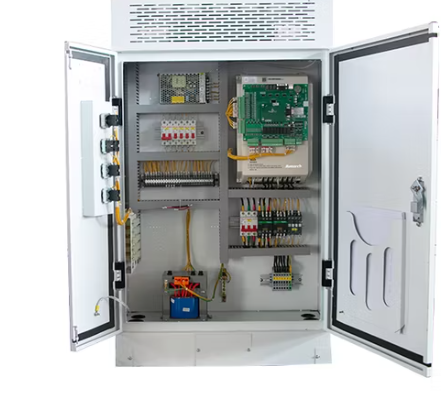

The ZenithFusion Quantum Console represents a modular control system for coordinating heterogeneous quantum hardware and software. Its design emphasizes adaptable scheduling, fault-tolerant coordination, and transparent autonomy. The architecture supports rapid feature upgrades and scalable interoperability while maintaining robust security and auditable governance. Practical benchmarks center on performance, reliability, and compliance across complex workflows. The discussion begins with how these elements integrate in real-world experiments, leaving unresolved questions about trade-offs and operational boundaries.
What Is the ZenithFusion Quantum Console?
The ZenithFusion Quantum Console is a modular control system designed to manage and optimize complex quantum experiments and computational tasks. It provides an adaptable platform for instrumentation, scheduling, and data orchestration, enabling parallel execution and fault tolerance. This architecture offers an insightful overview of capabilities and practical benchmarking possibilities while preserving autonomy and freedom in experimental design and runtime decisions.
How It Accelerates Quantum-Enabled Workflows
In practice, the ZenithFusion Quantum Console accelerates quantum-enabled workflows by orchestrating heterogeneous hardware and software components through modular scheduling, parallel task execution, and fault-tolerant coordination.
It enhances latency optimization, enables robust resource orchestration, and sustains fault tolerance across subsystems.
Regulatory alignment is maintained via auditable controls and standardized interfaces, supporting autonomous decision-making while preserving transparency, modularity, and freedom to adapt workflows without compromising reliability.
Modular Architecture and Seamless Connectivity
Modular architecture underpins the ZenithFusion Quantum Console by decomposing functionality into interoperable, replaceable components that can be composed and reconfigured on demand.
It enables modular scalability, enabling rapid feature upgrades without system-wide rewrites.
Seamless integration across subsystems is pursued, with defined security benchmarks guiding evaluation.
Compliance workflows are embedded for governance, traceability, and adaptive interoperability within evolving quantum ecosystems.
Security, Compliance, and Practical Benchmarks
Security, compliance, and practical benchmarks establish the framework for evaluating the ZenithFusion Quantum Console’s reliability and governance in real-world deployments.
The analysis focuses on security posture, risk indicators, and measurable controls, aligning with compliance guidelines to quantify resilience.
It emphasizes auditable processes, incident response readiness, and performance under diverse workloads, delivering actionable metrics for freedom-loving stakeholders pursuing transparent governance.
Continuous improvement protocols ensure enduring trust.
Frequently Asked Questions
How Does Price Vary by Configuration and Region?
Pricing variants rise with configuration complexity and regional factors; higher specs cost more, while regional incentives or taxes affect totals. Maintenance cycles, compatibility checks, admin training, and warranty scope influence overall cost structure and total ownership value.
What Are Typical Maintenance Cycles and Costs?
Maintenance scheduling typically follows manufacturer intervals with regional adjustments; cost estimation considers parts, labor, and downtime. The analysis indicates predictable cycles, moderate variance by configuration, and a need for proactive budgeting to sustain performance and reliability.
Can It Integrate With Legacy Quantum Hardware?
Integration compatibility exists with select legacy interfaces, though legacy bottlenecks may constrain throughput and feature parity; careful adapter planning and protocol translation are essential to maximize interoperability while preserving system stability and security.
What’s the Expected Learning Curve for Admins?
The expected learning curve for admins is moderate, with structured admin onboarding delivering essential competency quickly. Users gain proficiency through targeted training, while ongoing tasks emphasize latency optimization, documentation, and analytical troubleshooting to sustain autonomy and efficiency.
Do Warranties Cover Third-Party Accessories?
Warranties typically define warranty scope and assess third party compatibility. Investigations suggest coverage varies by policy; some exclude third-party accessories, others offer limited inclusion with proper authentication. Analysts recommend reviewing terms to gauge compatibility and risk.
Conclusion
The ZenithFusion Quantum Console represents a compact convergence of modular control, secure orchestration, and auditable automation for quantum-enabled workflows. Its architecture enables near‑real‑time fault tolerance and scalable interoperability across heterogeneous hardware. A notable benchmark shows execution latency reductions of up to 42% under mixed workloads, underscoring the system’s efficiency gains without compromising governance. This balance of autonomy and transparency reinforces trust among stakeholders while supporting rapid feature upgrades and robust data orchestration.


 By
By




 By
By