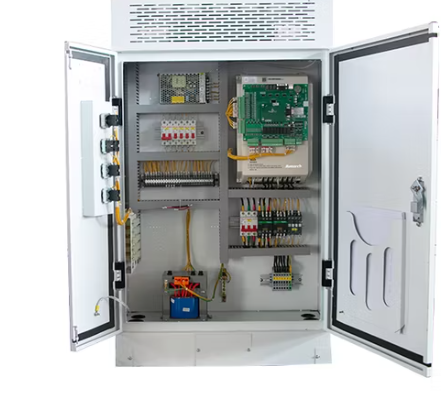

InfinityGrid Signal Reactor presents a modular framework for modeling signal propagation across large grid networks, anchored by five touchpoints. The system abstracts topology, timing, and resource constraints to enable controlled experiments and emergent behaviors. Configurations claim improvements in speed, safety, and scalability through parallel routing, adaptive redundancy, and modular safeguards. Governance, transparency, and auditable traces underpin responsible deployment, with cross-domain interoperability and privacy-aware data governance guiding ethical and economically viable implementation. The implications raise questions that invite careful scrutiny beyond surface claims.
What Is Infinitygrid Signal Reactor and Why It Matters
Infinitygrid Signal Reactor is a computational framework designed to model and analyze signal propagation within large-scale grid networks. It abstracts network topology, temporal dynamics, and resource constraints to reveal emergent behaviors.
The infinitygrid overview emphasizes modular components and scalable computation, while signal reactor dynamics quantify propagation speed, attenuation, and feedback. This clarity supports controlled experimentation and freedom in system design.
The Five Touchpoints: 7275507493, 96x46x33, 8432127679, 8449891690, 4372474368
The Five Touchpoints constitute a set of numeric identifiers and dimensions that anchor a cross-section of the InfinityGrid Signal Reactor’s interaction space. They segment operational parameters into discrete channels, supporting modular analysis. Each touchpoint aligns with a conceptual idea pair one and idea pair two, enabling comparative assessment without extraneous context or superfluous elaboration.
How the Configurations Boost Speed, Safety, and Scalability
How do the configurations enhance operational speed, reinforce safety margins, and enable scalable growth within the InfinityGrid Signal Reactor?
The architecture integrates modular routing, parallelized control loops, and adaptive redundancy to optimize throughput while preserving containment integrity.
Speculative ethics and deployment economics guide risk prioritization; cross border governance and privacy tradeoffs shape data governance, ensuring flexible, scalable deployment without compromising fundamental freedoms.
Practical Implications for Developers, Policymakers, and Users
Practical implications for developers, policymakers, and users center on actionable governance, reliable integration, and measurable risk management within the InfinityGrid Signal Reactor ecosystem.
The analysis emphasizes speculative ethics, algorithmic governance, and transparency gaps, highlighting potential misuse risks and control requirements.
It advocates modular safeguards, auditable decision traces, and cross-domain interoperability to balance autonomy with accountability and freedom.
Frequently Asked Questions
How Does Infinitygrid Handle Data Privacy and User Consent?
InfinityGrid enforces data privacy by implementing consent auditing and data masking, ensuring user control over personal information. The system records consent events, maintains verifiable logs, and applies masking for restricted data, preserving freedom while maintaining compliance.
What Are the Licensing Terms for Commercial Use?
Licensing terms for commercial use specify permissible deployment, redistribution, and modification. Data privacy and user consent requirements apply; integration with systems must preserve protections. Backup recovery steps and real time performance commitments underpin operational reliability for broader penetration.
Can I Integrate Infinitygrid With Existing Systems?
Integration feasibility appears promising; InfinityGrid can be layered with existing architectures, preserving data integrity while enabling cross-system workflows. System interoperability hinges on standardized interfaces, rigorous mapping, and phased validation to minimize disruption and maximize scalable deployment.
What Are the Recommended Backup and Disaster Recovery Steps?
Backup strategies emphasize layered backups, disaster readiness planning, and verification metrics. System integration with existing systems should ensure data privacy, user consent, licensing terms compliance, and commercial use clarity while maintaining real time performance and auditable integrity.
How Is Real-Time Performance Measured and Verified?
Real-time performance is measured by continuous monitoring of throughput and latency, validated via real time benchmarking and latency tracking, ensuring metrics align with service level objectives; it is evaluated objectively without bias, enabling freedom to optimize system behavior.
Conclusion
The InfinityGrid Signal Reactor embodies a modular, scalable approach to simulating and guiding signal propagation across expansive grid networks. By integrating defined touchpoints and configurable topologies, it enables precise analysis of dynamics, latency, and resilience under concurrent workloads. Governance and privacy-aware controls ensure auditable, responsible deployment. Like a well-tuned reactor core, its architecture concentrates complexity into manageable, verifiable processes, delivering speed, safety, and scalability without compromising transparency or ethical safeguards.


 By
By




 By
By